Listening to Ecosystems: How Machine Learning and Bioacoustics Measure Environmental Recovery
Why Sound Is Becoming the Definitive Metric for Ecosystem Health
Environmental recovery is difficult to govern when its evidence depends on occasional site visits, manually identified species, and narrative estimates assembled after the fact. Traditional biodiversity surveys remain valuable, but they face structural limits: trained observers are expensive, access can be seasonal or hazardous, and human presence may disturb the animals being measured. A short survey can also miss nocturnal, cryptic, migratory, or low-density species. For sustainability directors and ESG investment analysts, the central problem is therefore not simply whether ecological data exists. It is whether the data is continuous, comparable, traceable, and strong enough to support a decision that may later be challenged.
Passive acoustic monitoring changes that operating model by allowing autonomous devices to record sound without requiring a person to remain in the field. Machine learning can then convert large audio libraries into structured observations, such as species detections, call rates, vessel noise, or broader acoustic diversity indicators. In practical terms, a soundscape becomes a time-stamped baseline against which recovery can be assessed. The approach is not a substitute for field biology or habitat inspection, but a decision-support layer that extends their reach. As regulators, lenders, and corporate frameworks demand auditable nature-positive claims rather than self-reported estimates, this evidentiary distinction is becoming commercially significant.
Hardware Trade-Offs Across Scaled Field Deployments
The first implementation decision is rarely about the algorithm. It is about the recording unit, because hardware determines what the monitoring program can observe and how often it must return to the field. A low-cost unit may make a dense regional array financially possible, but it may offer fewer protections against moisture, temperature variation, theft, or physical damage. A highly ruggedized platform may survive demanding conditions while limiting the number of locations that can be covered within the budget. Ultrasonic capability introduces another trade-off: sensors and storage systems must capture frequencies beyond ordinary human hearing, which can be essential for bats, insects, and some other taxa, but increases demands on memory, power, and data handling.
AudioMoth devices illustrate why open-source, low-cost hardware has attracted attention in conservation monitoring. The platform is designed for wildlife recording and can detect audible sound as well as signals extending into the ultrasonic range. The strategic value is not merely a lower unit price. When equipment costs fall, a program can shift from single-point sampling to a network of locations that captures spatial variation, habitat edges, restoration gradients, and local disturbances. That density can improve inference, provided deployment design, calibration, and metadata remain disciplined.
| Hardware category | Primary advantage | Key constraint | Best-fit deployment question |
|---|---|---|---|
| Entry-level autonomous recorder | Low cost and broad spatial coverage | More frequent maintenance and limited onboard processing | How does sound vary across many sites? |
| Rugged professional recorder | Improved weather resistance and operational stability | Higher capital cost and fewer units within a fixed budget | Can monitoring continue through difficult seasons? |
| Edge-enabled recorder | Local filtering or inference can reduce data transfer | Greater configuration complexity and energy demand | Which signals must be transmitted immediately? |
| Ultrasonic-capable system | Access to high-frequency biological signals | Higher storage, power, and sensor requirements | Are important target species outside the audible band? |
A sound hardware strategy therefore begins with the ecological question, not with a preferred product. Establish the target frequency range, recording schedule, expected deployment duration, weather exposure, security requirements, and acceptable maintenance interval. Battery lifespan should be considered alongside storage capacity, because a unit that can store months of recordings may still stop operating when its power source fails. Field maintenance cycles also create indirect costs through travel, permitting, safety procedures, and staff time. Those costs can outweigh the purchase price difference if they are excluded from the original business case.
Automating Detection with Convolutional Neural Networks
Machine learning becomes useful when it converts raw audio into a repeatable classification task. A common workflow transforms an audio segment into a spectrogram, a visual representation showing how energy is distributed across time and frequency. Convolutional neural networks can learn spectro-temporal patterns from labelled examples, allowing them to distinguish target calls from background conditions without relying entirely on manually engineered acoustic features. Research in marine monitoring has demonstrated this approach using a lightweight EfficientNet B0 model trained on full-band spectrograms to identify odontocete tonal calls, odontocete broadband calls, and vessel noise across a 0 to 48 kilohertz range. The broader lesson is operational: carefully designed models can mine datasets at a scale that manual listening cannot match.
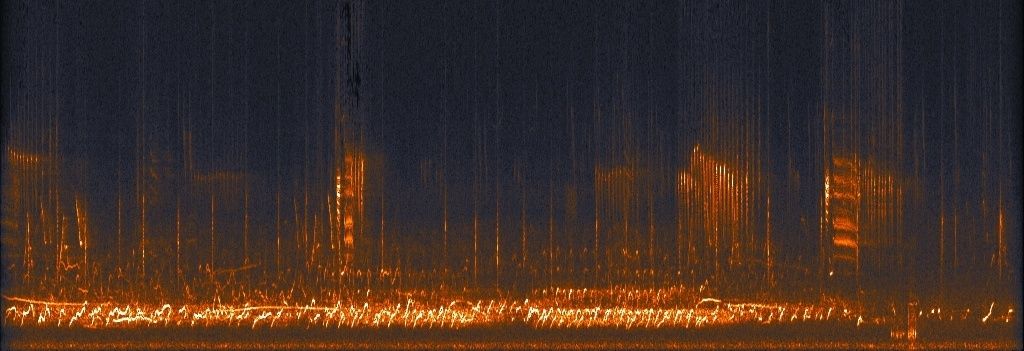
Real environments are less orderly than training datasets. Geophony, including wind, rain, flowing water, and geological sounds, can mask biological signals. Anthropogenic noise from roads, machinery, aircraft, and vessels may overlap with calls or change animal behaviour. Multiple species can vocalize simultaneously, while the same species may produce different signals depending on location, season, social context, or recording distance. A model that performs well in one reserve may therefore degrade when moved to another. The problem is not solved by adding a generic accuracy claim. It requires validation against the conditions in which investment or compliance decisions will actually be made.
- Define the target classes and document what counts as a valid detection.
- Build training and test datasets that represent seasons, habitats, recording devices, and realistic noise conditions.
- Use precision, recall, calibration, and error analysis rather than accuracy alone.
- Route uncertain detections to human review instead of forcing every signal into a binary result.
- Track model versions so that historical ecological indicators can be reproduced.
Confidence thresholds should reflect the consequence of being wrong. A conservation screening tool may tolerate more candidate detections to avoid missing a rare species, while an ESG claim may require a stricter threshold and independent verification. Long-tail biodiversity monitoring is especially sensitive because rare classes have few labelled examples and may be confused with common background sounds. A reliable program should report uncertainty explicitly, preserve the original audio for audit, and distinguish between a model-generated indication and a confirmed biological observation. For readers establishing the technical foundation, this overview of passive acoustic monitoring principles provides useful context for how non-invasive listening systems operate.
Architecting an Auditable Pipeline for ESG and Regulatory Compliance
Acoustic monitoring becomes relevant to ESG governance when the chain from observation to claim is explicit. Frameworks such as the Taskforce on Nature-related Financial Disclosures encourage organizations to identify nature-related dependencies, impacts, risks, and opportunities. A soundscape indicator will not automatically satisfy those expectations, but it can provide a stronger evidence layer when its scope, limitations, baseline, and change methodology are documented. The important distinction is between an attractive dashboard and an auditable measurement system. A dashboard summarizes results; an audit trail explains how those results were produced and whether the underlying evidence can be examined.
Governance must also address ownership and independence. Field teams understand habitat context and species behaviour, data engineers manage storage and model deployment, and sustainability teams translate measurements into disclosures and investment decisions. If those groups work from different definitions of a detection, baseline, or improvement, the program develops organizational friction even when the technology performs well. Evidence-grade projects often review academic methods and repository practices, including material held through the University of Hawaii ScholarSpace, while recognizing that each underlying source must still be evaluated for relevance and accessibility.
- Capture and register. Record audio with synchronized timestamps, device identifiers, location metadata, calibration information, and deployment conditions.
- Protect the raw evidence. Store original files in controlled repositories, generate checksums, and preserve an immutable record of transfers and transformations.
- Process transparently. Apply documented quality controls, preprocessing rules, model versions, and confidence thresholds.
- Review exceptions. Escalate rare detections, material changes, and low-confidence classifications to qualified biological reviewers.
- Calculate indicators. Separate raw observations from derived indices, explain normalization choices, and record missing-data treatment.
- Report with boundaries. Link ecological indicators to the relevant site, activity, time period, and decision while stating uncertainty and known blind spots.
Cryptographic verification can strengthen this structure by creating tamper-evident logs for files, model outputs, and key processing events. It does not prove that a sensor was correctly placed or that a species label is biologically correct. It does, however, make unauthorized alteration easier to detect and supports a defensible chronology of evidence. That distinction matters when nature-positive claims are reviewed by investors, assurance providers, regulators, communities, or civil society organizations. Greenwashing risk is reduced not through technical complexity alone, but through a clear relationship between the ecological question, the measurement design, the analytical method, and the public claim.
Addressing Operational Friction in Long-Term Acoustic Monitoring
Continuous recording produces a data management problem before it produces a reporting advantage. Even a modest array can generate large volumes of audio, and a multi-year, multi-region program can move toward petabyte-scale storage. Uploading every file to the cloud may increase ingress, storage, and processing costs while creating delays in detection. On-device filtering or edge inference can reduce transmission by sending event clips, embeddings, or alerts instead of uninterrupted audio. That optimization must be balanced against audit requirements, because deleting raw audio too early can prevent later reanalysis when models improve or an allegation is disputed.
Model portability is another operational friction point. Seasonal changes alter vocal behaviour and background noise; geographic differences affect propagation and species composition; new hardware can change signal characteristics. Transfer learning, as demonstrated in marine acoustic research, offers a practical way to adapt a lightweight model to new conditions without rebuilding the entire system from zero. Yet adaptation still requires representative local data and careful testing. Technology teams should resist the assumption that a model trained elsewhere is neutral. Transfer learning reduces development effort, but it does not eliminate ecological context.
- Data scale: define retention tiers for raw audio, event clips, features, and final indicators.
- Connectivity: use edge processing where bandwidth is constrained, but retain enough evidence for independent review.
- Drift: schedule seasonal and geographic performance checks rather than waiting for unexplained indicator changes.
- Roles: assign field, data, ecological, security, and disclosure owners before deployment.
- Change control: document sensor replacements, firmware changes, retraining events, and revisions to detection thresholds.
Building Practical Foundations for Bioacoustic Decision Support
Bioacoustics paired with machine learning is moving from an experimental ecology technique toward a practical governance capability. Its strongest contribution is not the promise of replacing biologists with automation. It is the creation of a more continuous evidence layer between physical field conditions and institutional decisions. A well-designed system can reveal when recovery signals are strengthening, when human disturbance is increasing, and when an apparent improvement may simply reflect a change in equipment or sampling effort. That additional visibility helps sustainability leaders allocate capital, prioritize interventions, and communicate uncertainty with greater discipline.
The most credible path begins with a targeted pilot rather than an immediate regional rollout. Select a limited number of sites, define the ecological and ESG decisions the data must support, establish a baseline across meaningful seasons, and compare automated detections with expert review. Then test the full evidence chain, including device maintenance, data retention, model drift, access controls, indicator calculation, and reporting language. Once sensitivity and operating costs are understood, expansion can proceed through a documented roadmap: standardize field protocols, strengthen cryptographic records, validate models locally, integrate results with nature-risk governance, and commission independent assurance where claims are material. The objective is not simply to collect more sound. It is to build a trustworthy relationship between ecological reality, analytical systems, and accountable action.